
March 9, 2016. Seoul, South Korea.
Lee Sedol, 18-time world Go champion, sat down to face AlphaGo, Google DeepMind’s AI program. Experts had said this moment was a decade away. Go requires intuition, creativity, pattern recognition built over a lifetime. It was supposed to be uncrackable.
AlphaGo won 4-1.
In Game 2, it played Move 37. A move so unconventional that every commentator in the room assumed it was a mistake. Lee got up and left. When he came back and saw it properly, he sat in silence for more than twelve minutes.
No human had ever played that move. The machine had not learned it from anyone. It had invented it.
Lee Sedol announced his retirement two years later. “With the debut of AI,” he said, “I’ve realised I’m not at the top even if I become the number one.”
Most of us watched, marvelled, and moved on.
I think we made a mistake doing that.
Because the question was never whether AI could beat us at defined tasks.
It always could. That was just a matter of time.
The question nobody is sitting with long enough is this: what happens to human thinking when we stop needing to do it?
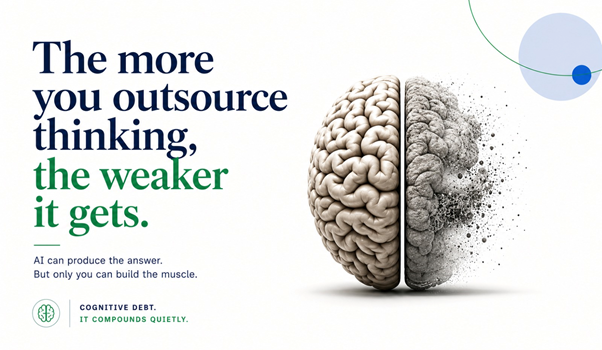
A 2025 MIT study tried to find out. They split participants into three groups. One used AI to write essays. One used search engines. One worked with nothing but their own brain. The AI group finished fastest, by a distance. They also showed significantly weaker neural connectivity, lower memory retention, and a reduced sense of ownership over their own work.
Faster. Less theirs. Less remembered.
And then there is the BCG finding, which is the one that really stays with me.
Harvard Business School and Boston Consulting Group studied 758 consultants. On tasks inside AI’s capability zone, the AI group performed better. Faster, higher quality, more output.
Fine, expected.
But on complex judgment tasks, the kind that define what a senior professional actually gets paid for, those using AI performed 19% less than those using nothing at all.
The AI did not obviously fail. The output looked polished. Structured. Coherent. Consultants accepted it without question. They would have caught the error if they had done the work themselves.
The researchers called it falling asleep at the wheel.
That phrase has not left me since I read it.
I want to give you two examples because I think the abstract version of this is too easy to dismiss.
A financial analyst uses AI to draft every sector report now. Clean output, well structured, looks great. What it cannot surface is the view he has been quietly building for eighteen months, that the metric his entire industry uses to value a particular sector is fundamentally flawed. That view lives inside him. It is uncomfortable, half-formed, not yet backed by consensus. Every time he opens the tool before he thinks, that view gets a little harder to reach.
A senior journalist uses AI to research every major feature. Comprehensive. Efficient. But two years ago she would spend days just sitting with a story, following threads that felt important before she could explain why. That instinct kept surfacing things the data had not caught up to yet. AI cannot follow a hunch. It can only tell you what has already been found.
Neither of them is failing. Both of them are slowly becoming less themselves at work.
And I do not think they have noticed yet.
Here is the thing about AI that we keep glossing over.
It is trained on everything that has already been thought. Every framework, every published insight, every best practice someone else produced before you arrived.
The thought nobody has had yet is not in there. It cannot be. It has to come from you.
But only if you still have the capacity to produce it. And that capacity does not disappear overnight. It just quietly shrinks every time you skip the discomfort of not knowing and go straight for the answer.
The output looks good, but that is exactly the trap. Looking good and being original are not the same thing, and the gap between them is exactly where professional value lives.
Three things worth actually changing, not just nodding at.
Solve the problem before you prompt. Write your own rough, possibly wrong, definitely messy answer first. What do you actually believe is going on here? What would you do? Ten minutes, no tools. Then go to AI and use it to challenge what you wrote. Think first, use
AI as the pressure test, not the starting point.
Question the assumption behind the question. The most valuable thing a professional can do, and the thing AI is genuinely useless at, is recognizing when the wrong problem is being solved. Before any piece of work, ask what assumption is baked into this question. Is it actually true?
Build the counterargument yourself before AI hands you a comfortable one. What would make you wrong? Who would push back on this recommendation and why?
If you cannot write a credible opposing view in your own words, you do not understand the problem well enough yet.
What is actually at stake here is not your job title.
It is your judgment. The thing that took years to build and can erode quietly without you realizing it is happening.
AlphaGo’s Move 37 was extraordinary because it had no attachment to convention. No memory of the right way. No need to look competent to a watching crowd. It just found the move that worked.
That is a remarkable thing. And it is completely useless for what makes a human professional irreplaceable, which is the willingness to sit in genuine discomfort, to hold an inconvenient view before anyone else sees it, and to say out loud in a room full of people who have already agreed: I think we are solving the wrong problem.
Lee Sedol lost the series. But Game 4, the one he won, was entirely his. No prompt generated it. It came from a human who had spent a lifetime building the judgment to see something the machine could not.
That is what is worth protecting.
So before you open the tool today, what do you actually think- Write that down first.
This article is authored by Ikshwaku Sharma CEO, Rescript Consultancy