
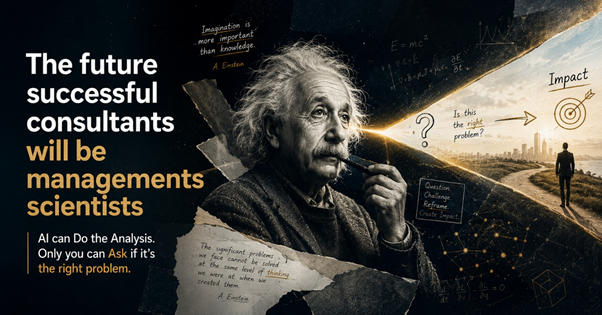
In 1895, a 16-year-old Swiss student with no laboratory, no funding, and no credentials started asking a question nobody else thought was worth asking.
What would happen if you could chase a beam of light?
No AI. No data room. No 200-slide deck.
Just a teenage boy, a daydream, and a refusal to accept what every trained physicist around him had already stopped questioning.
Now hold that thought, and step into a typical consulting engagement in 2026.
The client briefs the team. The team deploys AI. Research is synthesised in hours. Frameworks are applied. A polished deck lands in the boardroom in days, not weeks.
And the recommendation? Probably correct. Probably well-structured. Probably built on a question nobody stopped to interrogate.
Is this the right problem to be solving?
That is the question most engagements never ask. And increasingly, it is the only question that matters.
The frameworks we were trained on are starting to show their age.
Porter’s Five Forces was built for a world of stable industry boundaries. The Growth-Share Matrix assumed that market share was the primary driver of competitive advantage. Both were brilliant for 1980.
Today, a platform business can dissolve an entire industry’s competitive structure overnight. A startup with no assets can outvalue incumbents with decades of market share. The “Cash Cow” you protected last year is the “Dog” you are defending this year.
When the world moves faster than the framework, the consultant who defaults to the template is not adding insight- they are adding comfort.
The management scientists, the ones who treat every brief as a hypothesis to be evaluated with evidence rather than a question to be answered, are the ones who will matter.
Two examples worth sitting with.
When Reed Hastings pushed Netflix toward streaming in 2007, the internal data pointed clearly toward DVD-by-mail as the core business. Every conventional framework said: protect the Cash Cow, expand the distribution moat. A standard competitive analysis would have reached the same conclusion.
What changed the decision was a different kind of question: What business are we actually in?
Not “what are we good at today” but “what will matter in ten years?”
That is a management science question, probabilistic, forward-looking, and willing to invalidate its own prior assumptions.
Closer to what most of us experience daily: in the early 2000s, IBM’s Global Services was watching clients demand cost-cutting rather than transformation. The instinct was to comply, price lower, deliver faster. What the team eventually recognised was that clients were describing a cost problem but experiencing a capability problem. Reframing that single assumption shifted IBM’s services business from a race to the bottom into one of the most profitable B2B transformations of that decade.
Neither shift came from a better analysis of the same question. Both came from someone willing to challenge and reframe the question itself.
This is the only sustainable edge a consultant has left.
AI can build your framework. AI can synthesise your research. AI can write a recommendation that sounds like it came from a senior partner.
What AI cannot do is walk into a boardroom and have the judgement and conviction to say: I think you are solving the wrong problem.
That sentence, delivered with evidence, with intellectual courage, and with a point of view the client has not paid ten other firms to produce, is worth more than any output AI will ever generate.
Peter Drucker understood this decades ago. Management, he argued, is not fundamentally about efficiency. It is about judgment, the deeply human ability to look at a situation and understand what it actually means beyond what the numbers say.
The consultant who thrives in the next decade is the one who thinks like a scientist: forms a hypothesis, challenges it ruthlessly, uses AI to gather data and sharpen it, and then brings something original into the room.
That combination, however rare, is becoming more valuable, precisely because everything else is being automated.
The question is worth leaving you with.
Einstein changed the course of physics with a daydream about light. He had no tools that his contemporaries did not have. What he had was the willingness to question something everyone else had already accepted as settled.
The next generation of great consultants will change their clients’ businesses the same way, not by being faster, not by having better tools, but by being the person in the room who asks the question everyone else stopped asking.
What assumption are you currently working around in your engagements that nobody has actually stopped to challenge?
This article is authored by Ikshwaku Sharma, CEO – Rescript Consultancy